How to Start a Pool Cleaning Business in Florida
How to Start a Pool Cleaning Business in Florida
Pool cleaning is one of the more accessible service businesses to start in Florida, where pools are common at homes, hotels, apartment complexes, and HOA communities. The entry cost is lower than most trades. You do not need a state license to clean pools, and you can start with a vehicle, basic tools, a test kit, and a short list of customers. The paperwork is still real: you need a legal entity, a compliant business name, a Florida registered agent, local tax registration, and a plan for handling chemicals safely.
This guide covers the steps in the order most new owners find useful. It is informational content, not legal or tax advice. Confirm each requirement with the agency named before you spend money or sign anything.
Do You Need a Florida Pool Cleaning License?
For cleaning alone, no. The Florida Department of Business and Professional Regulation (DBPR) publishes a list of occupations that do not require a state license, and pool cleaning is on that non-licensed list. Search the DBPR website to confirm the current listing yourself, because the agency's list controls, not this article.
The line falls at repair work. Repairing or replacing pumps, heaters, or plumbing for pay requires a pool/spa servicing contractor license. New owners often cross this line without noticing, because a cleaning customer asks for a pump swap on the same visit. Do not perform or quote paid repair work until you have confirmed with DBPR which license applies and whether you qualify. Refer repair jobs out in the meantime.
Florida has no general statewide business license. Your city or county may levy a local business tax receipt, covered below, but that receipt is a tax, not a test of your competency.
Materials and Tools You Will Need
Startup cost depends on whether you build a customer base from scratch or buy an existing route. The list below covers the core items. Price each one locally before you commit.
- Articles of Organization for an LLC, plus a Florida registered agent
- A federal Employer Identification Number (EIN) from the IRS, which is free
- A fictitious name registration, if you will operate under a name other than your LLC name
- Local business tax receipt applications for each city or county where you operate, where one applies
- A Florida Department of Revenue sales and use tax registration, if your sales are taxable (confirm first)
- Commercial general liability insurance and commercial auto coverage
- A work vehicle with a lockable, ventilated storage area for chemicals
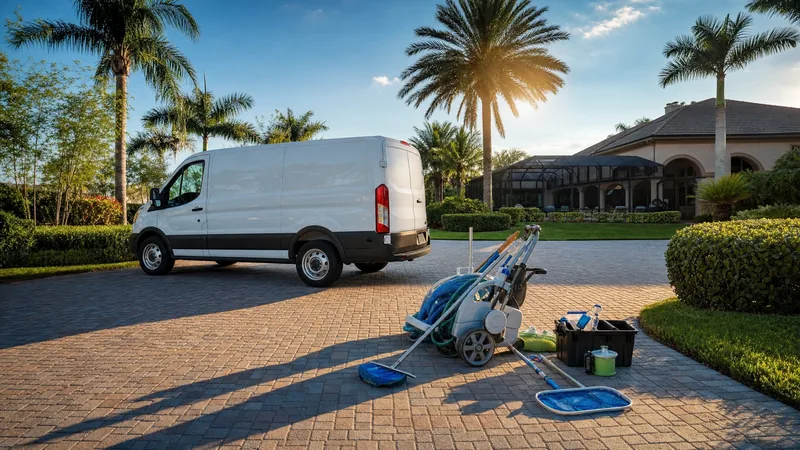
- Telescopic poles, skimmers, brushes, and a vacuum head, manual or robotic
- A test kit that measures free chlorine, pH, total alkalinity, and calcium hardness, with spare reagents
- Chemical containers, secondary containment trays, and a spill kit
- Gloves, eye protection, and chemical-resistant footwear
- Safety Data Sheets (SDS) for every product you carry, kept in the vehicle and in your office file
- Route software or a spreadsheet for addresses, service dates, and billing
- A written service agreement template and a customer intake form
Step-by-Step: Starting Your Pool Cleaning Business
- Define your services. Decide whether you will clean only or also perform repairs. That choice determines whether you need the pool/spa servicing contractor license, and it affects your insurance and pricing. Most new owners start with weekly cleaning and chemical balancing, then add repairs only after the license is in hand.
- Check local rules before you choose a name. Ask the city or county where you will operate whether a business tax receipt applies and whether a home-based business can keep vehicles or chemicals on the property. If you plan to service HOA communities, ask the association about commercial vehicle and parking rules too.
- Choose a legal structure. A single-owner LLC is the most common choice for a service business because it can separate your personal assets from business debts and claims, though that protection depends on how you run the company. Florida has no personal income tax. An LLC taxed as a partnership or disregarded entity generally does not file a Florida corporate income tax return, while a corporation pays Florida's 5.5% corporate income tax. Talk with a CPA before you choose, especially if you plan to take on partners or borrow to buy a route.
- Search and reserve your name. Search the Sunbiz business records at search.sunbiz.org before you settle on a name. An LLC name must end in Limited Liability Company, LLC, or L.L.C., and it must be distinguishable from names already on state records. You can reserve a name for 120 days for $25. Do not treat the name as approved until you receive a filing acknowledgment.
- File the Articles of Organization. File through Sunbiz eFile for $125, which is the $100 filing fee plus the required $25 registered agent designation. Florida does not offer expedited filing and publishes no guaranteed turnaround. Online filings are processed in the order received. If you need the filing faster, use the walk-in service at 2415 N. Monroe Street, Suite 810, Tallahassee, Monday to Friday, 8am to 5pm, where most requests are completed while you wait.
- Appoint a registered agent. Every Florida LLC must designate a registered agent with a physical Florida street address. A P.O. Box does not qualify. The agent must sign to accept the appointment. An individual owner or officer may serve, but the LLC cannot serve as its own agent. The designation carries a $25 fee for an LLC, and changing agents later costs the same $25.
- Get an EIN. Apply for a federal EIN through the IRS. It is free, and you need it to open a business bank account, hire employees, and file certain tax returns.
- Register a fictitious name if you need one. If customers will see a brand name such as Sunshine Pool Care rather than your LLC name, file a Fictitious Name Registration with the Division of Corporations. Registration costs $50, and renewal costs $50. A registration is valid for 5 years and expires December 31 of the fifth year. Renewal is filed between July 1 and December 31 of the expiration year. The name must be advertised at least once in a newspaper in the county of your principal place of business. No proof of advertisement is filed, but the requirement still applies. Filing is statewide, not county by county.
- Determine your sales tax position. Register with the Florida Department of Revenue if your business sells taxable goods or services. The state sales tax rate is 6%, and some counties add surtaxes. Whether pool cleaning services themselves are taxable is a question to confirm with the Department of Revenue, not something to assume. If you sell chemicals or parts, ask whether you must collect tax on those sales and register before your first sale.
- Get your local business tax receipt. The local business tax receipt is authorized under Chapter 205 of the Florida Statutes. It is a tax, and not every county or city levies one. Confirm with the local tax collector for the address where you operate, and ask whether the receipt is tied to your business address, your home, or both.
- Evaluate a route before you buy it. Buying a pool route for sale in Florida is the fastest way to start with recurring revenue, and it is where many new owners overpay. Ask for the customer list with service history, the pricing for each pool, and the billing records. Confirm which accounts have written service agreements and whether those agreements allow assignment to a new owner. Drive the route yourself to see how close the stops are. Ask for the seller's chemical and equipment inventory, and make sure the purchase agreement states exactly what transfers. Have an attorney review the contract and a CPA review the numbers before you sign.
- Set up chemical storage. Keep chemicals in their original labeled containers and never combine products. Store oxidizers, acids, and chlorine products apart from each other, following the Safety Data Sheets. Use secondary containment trays, keep the area dry and out of reach of children and pets, and do not keep chemicals in a living space or a vehicle cabin. Confirm storage rules for your home, vehicle, and any shop with your local fire marshal or county office, and check your homeowners policy before storing chemicals at home.
- Insure the business. Ask an insurance agent about commercial general liability coverage for property damage and injury at customer pools, and commercial auto coverage for your work vehicle. Ask whether the policy covers chemical handling. If you plan to hire, confirm your workers' compensation obligations before the first hire, because the requirement depends on your business and headcount.
- Write agreements and keep records. Use a written service agreement for every account. It should cover service frequency, what is included, what costs extra (such as chemicals or filter cleaning), the payment schedule, cancellation terms, and how you access the property. Log every visit with the date, water readings, chemicals added, and any problems. Those notes protect you in a dispute.
- Calendar your annual report. An LLC annual report is due each year between January 1 and May 1. The fee is $138.75. A $400 late fee applies to reports received after May 1, for a total of $538.75. Failure to file by the third Friday in September leads to administrative dissolution. Put the deadline on your calendar the day your articles are filed.
Tips for Getting Started Well
- Price by pool, not by hour, once you know your average drive time and service time. Put chemicals and extra visits in the written agreement so customers are not surprised by them.
- Open a separate business bank account from day one. Mixed funds make tax filing and any future sale harder.
- Use a business email address you will keep for years. State and tax notices go to the address on file.
- Check your county's and city's rules on commercial vehicles in residential areas before you buy a branded vehicle wrap.
- Use the Florida SBDC Network at floridasbdc.org for advising on planning and pricing.
Common Mistakes to Avoid
- Doing paid repairs before the license is confirmed. A cleaning visit that turns into a paid pump or heater replacement can take you outside what a cleaning-only business is allowed to do. Confirm with DBPR before you quote the work.
- Assuming the name is available. A search or a reservation is not approval. Wait for the filing acknowledgment.
- Using a P.O. Box for the registered agent. Florida requires a physical street address.
- Skipping the route audit. A list of accounts is not a route. Verify each stop, each agreement, and each price yourself.
- Storing chemicals casually. Mixing products, storing acids next to chlorine, or keeping unlabeled containers creates fire, fume, and injury risk, and a chemical incident can create liability your policy does not cover.
- Missing the annual report window. Filing between January 1 and May 1 costs $138.75. Filing after May 1 adds a $400 late fee, and missing the third Friday in September can lead to administrative dissolution.
- Assuming your county has no business tax receipt. Not every county or city levies one, but many do. Check with the local tax collector before you start.
- Treating the local receipt as a license. It is a tax. It does not certify your skills or your right to perform repairs.
What Results to Expect
Pool cleaning is a recurring service, so your first goal is consistent weekly visits rather than one strong month. Customers may notice clearer water and fewer maintenance calls when readings stay in range and filters are cleaned on schedule. Referrals often follow reliable visits, but results depend on your local market, your pricing, the density of your route, and the condition of the pools you take on.
No one can guarantee income from a pool route. A purchased route can lose accounts after a sale, and customers may cancel for reasons unrelated to your work. Build a budget that assumes some churn, and set aside money for insurance, chemicals, fuel, and taxes before you pay yourself. Treat these figures as planning estimates, not promises.
Next Steps and When to Get Professional Help
This article is informational, not legal or tax advice. Florida's rules on entity formation, sales tax, licensing, and chemical storage can change, and your situation may differ from the examples here. Before you sign a route purchase agreement, bring in a partner, or decide whether your sales are taxable, consult a qualified Florida attorney and a CPA. Your insurance agent can confirm coverage, and your county tax collector can confirm the business tax receipt.
Official Florida Resources
- Florida Department of State, Division of Corporations (Sunbiz): https://dos.fl.gov/sunbiz/
- Name search: https://search.sunbiz.org/Inquiry/CorporationSearch/ByName
- Sunbiz eFile for Florida LLCs: https://dos.fl.gov/sunbiz/start-business/efile/fl-llc/
- Fictitious Name Registration: https://dos.fl.gov/sunbiz/start-business/efile/fl-fictitious-name-registration/
- Florida Department of Revenue: https://floridarevenue.com/
- Sales tax registration: https://floridarevenue.com/taxes/eservices/Pages/registration.aspx
- Florida SBDC Network: https://floridasbdc.org/
Keep exploring: related Florida guides
- How to Start a Pest Control Business in Florida
- How to Start a Pressure Washing Business in Florida
- How to Start a Mold Remediation Business in Florida
- How to Start a Cleaning Business in Florida
- How to Get a Contractor License in Florida
- How to Start an LLC in Florida
- Florida Business License
- How Much Does It Cost to Start a Business in Florida
- All Florida business types
- Every Florida guide in one place